
Dallas Address Records by Era
Past residents of a Dallas address leave different kinds of evidence in different periods. The current parcel card provides the starting address, account, and legal description. The County Clerk's official-records index follows recorded instruments and their named parties, while printed directories document what appeared at an address in a particular edition. The Texas State Library route and Dallas Public Library microfilm become more important when an older record has no convenient web result. Treat the sources as a trail, not as interchangeable proof.
| Dallas source | Period located | Access route | What it can show |
|---|---|---|---|
| County Clerk official-records index | County custody begins in 1846; online-index start not located | Free index, image or certified-copy route separately | Recorded parties, instrument trail, document type, and legal-description clues |
| Criss-cross and reverse directories | 1936 and 1960-1994 identified in the LOC Dallas inventory | DPL and Library of Congress routes | Address-to-printed-occupant or owner-style trail, with gaps possible |
| Digitized Dallas directory pages | 1875 date view; 1918, 1924, 1928, and 1938 pages inspected | Portal to Texas History | Street numbers, names, units, vacancies, intersections, and page images |
| County and civil microfilm | District civil papers 1846-1938; other series vary | Texas State Library guide and DPL reels | Direct/reverse indexes, minutes, case papers, and older county material |
| Federal census and newspapers | Federal schedules follow the 72-year access rule; newspaper coverage varies | Library databases and microfilm | Household and event-date context to test an address trail |
Start with the source closest to the period at issue. A recent parcel chain may begin at DCAD and the Clerk index. A family-history question from the 1930s may begin in a reverse directory, then move to newspapers or microfilm. Note: A current property record should not be used to overwrite a historically printed address form.
Dallas Parcel Records at DCAD
For a Dallas address, begin the backward trail with the Dallas Central Appraisal District property search. Save the account number, situs address, owner name, owner mailing address, legal description, and map position. Those fields should be kept apart. The situs is the parcel's physical location. The mailing address is where tax correspondence goes and may be elsewhere. The legal description can name a subdivision, block, lot, acreage, or abstract even when an old document has no modern street number.
DCAD lets a searcher work by owner name, account number, street address, business name, or map. Its address form supports a number, direction, street name, building, suite, city, and a numeric range. The street-name field requires at least two characters and advises omitting the street type. A percentage sign can be used for an uncertain spelling. Those settings help normalize the present parcel before earlier entries are assigned to it.
- Situs address
- The physical parcel location used by DCAD and map layers.
- Mailing address
- The address shown for appraisal correspondence, which is not evidence that an owner lives at the situs.
- Legal description
- The subdivision, block, lot, acreage, or abstract language that can survive an address change.
The DCAD card gives an appraisal identity, not a complete list of who lived there before. Its best role is to create a repeatable address and parcel starting point.
Dallas Deed Records in Sequence
The deed chain is the ownership branch of a Dallas address-history search. After saving the DCAD account and legal description, use the Dallas County Official Records Search. Its quick search accepts a grantor or grantee, subdivision, document type, or document number, with a recorded-date range. Select the department first. The free index and the image or certified-copy route are separate steps. A named grantor is a prior title party, not proof that person lived at the property.
- Find the current parcel in DCAD and save its account, situs, owner, and legal description.
- Search the current owner and the legal description in the County Clerk index, using grantor and grantee roles separately.
- Record the instrument number, recorded date, document type, party roles, and any subdivision or legal-description wording.
- Use the earlier party and description to locate the prior conveyance, then repeat the search backward.
- When a document or certified copy is needed, use the cart or the County Clerk mail-request route and record the order details.
- Grantor
- The party shown as transferring an interest in a recorded instrument.
- Grantee
- The party shown as receiving that interest in the instrument.
- Chain of title
- The dated sequence of recorded interests used to follow a parcel backward.
Plain copies are listed at $1 per page, and certified copies at $1 per page plus a $5 certification charge on the documented mail form. The form also requires payment and a prepaid self-addressed envelope. If a current street address fails, search the subdivision, block, lot, acreage, or party names instead.
Dallas Address History Since 1846
Dallas County was created on March 30, 1846, and the County Clerk says its custody of county records begins that year. Old Red's courthouse site history includes a brick courthouse rebuilt after the 1860 fire. That is a verified courthouse story, not proof that a particular deed or directory volume was lost. It explains why a search can move between county custody, library microfilm, and archive collections as the address trail gets older.
Dallas streets are not stable identifiers across every period. The Municipal Archives street-history research identifies numbering changes around 1891 and 1892, followed by a major downtown renumbering in 1911. A 1901 directory number may therefore need a street-history map, a nearby intersection, and a plat or legal-description check before it is paired with a present parcel. Do not feed an old number into DCAD and treat a no-result as proof that the address disappeared.
The 1924 Dallas address-directory page illustrates why old street listings should be read as printed, including abbreviated occupants and adjacent lines.
Use the street segment and neighboring entries as checks while reconciling a historic number with a map or recorded lot description.
Dallas Directory Address Entries
Directories supply the household branch of an address-history search. The 1938 Portal to Texas History street page visibly includes the street name and number, an occupant or business, rear-unit indicators, vacant entries, intersection notes, OCR text, and the page image. Compare the target with adjacent numbers in the same edition. Then compare the next available edition. A rear unit can be a distinct address, and a printed vacant line is a dated observation, not a continuous condition.
The 1938 Dallas street-listing page gives a clear example of the address details that should be transcribed.
Checking the page image protects against an OCR mistake and preserves the context of a unit, vacancy, or intersection note.
The 1928 Dallas alphabetic directory sample uses surname, given name, parenthetical identifiers, address markers, street address, and page-image evidence. Its printed abbreviations should remain unexpanded until the edition key supports a reading.
The name-to-address form can reveal a fuller name or a second yearly address before the trail returns to the same street.
Dallas Microfilm Records Route
When an older Dallas result is not in a portal, the microfilm route is part of the normal search path. The Texas State Library guide identifies Dallas County series by reel and includes District Court Civil Case Papers from 1846 through 1938, direct and reverse indexes, county minutes from 1846 through 1870 and later, and an inquest record for 1959 through 1969. The guide also notes that some reels are transposed or out of order. Write down the named series, year range, and reel before requesting access.
The Texas State Library Dallas County microfilm guide is the official route for identifying those series. Dallas Public Library provides the local microfilm access environment for the listed materials.
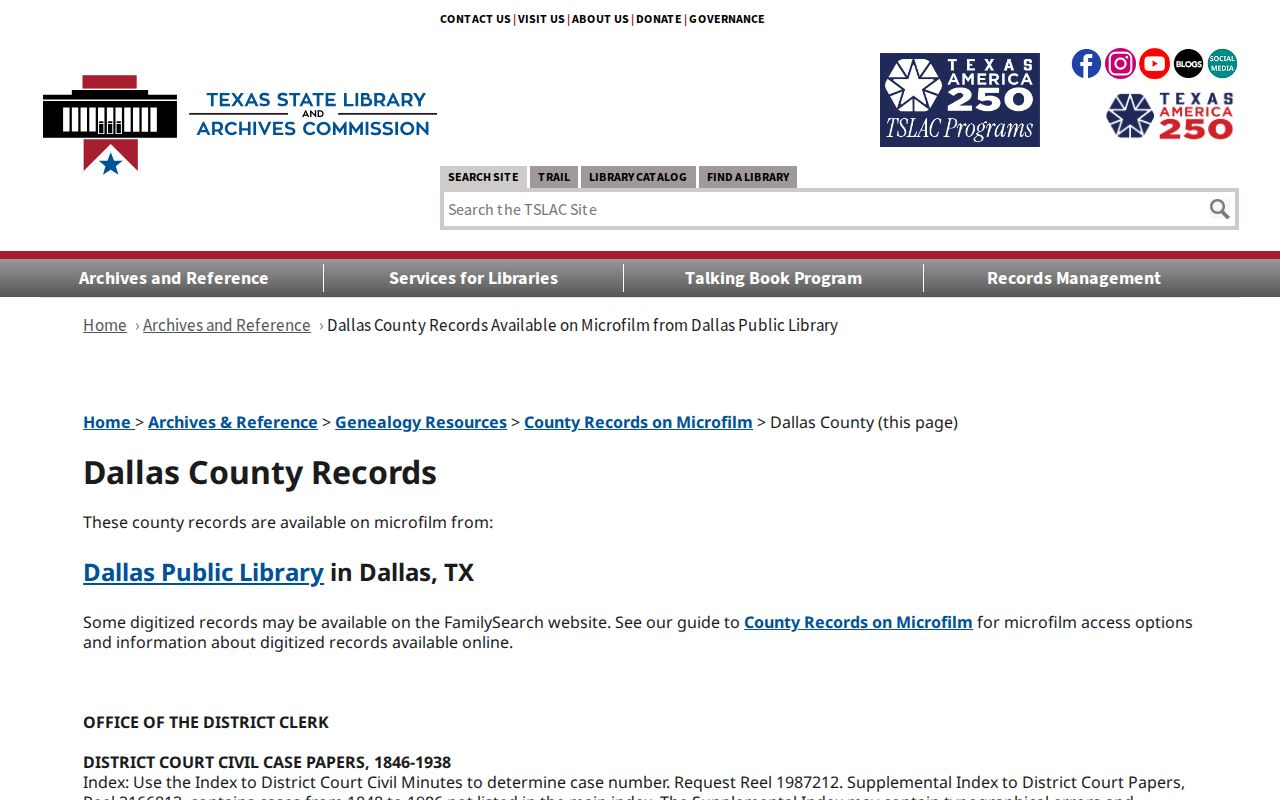
Microfilm is a fallback for missing online years, not a substitute for matching the reel's record type to the address question.
Dallas Past Households and Census
Ownership is only one part of who lived here before. Pair an address-ordered directory with the closest available census schedule, newspaper item, obituary, cemetery record, or probate file. The Dallas Public Library holds newspapers, yearbooks, directories, and microfilm, while Dallas County probate records can provide a separate estate trail. A directory may list one adult, a boarder, a business, or a rear unit rather than every household member. Keep the source date beside every conclusion.
Address flow: current DCAD situs and legal description → County Clerk instrument trail → historic directory address → census or newspaper date check → probate, cemetery, or obituary endpoint.
- Find the old address form in the closest directory and save its page image.
- Test the printed name and address against a census schedule for the relevant decade.
- Use an obituary, cemetery entry, or probate record only as an independent dated bridge.
- Return to the legal description when the directory number changes or the parcel splits.
The historical volumes themselves are described in the Dallas City Directory collections route, while the current address chain belongs with the Street Directory.
Dallas Record Proof Limits
Address-history research in Dallas works best for house history, family history, estate questions, and personal reconnection. A record party, an appraisal owner, and a directory occupant are not the same thing. Use the smallest amount of personal information needed for the historical question and verify important claims with the custodian that holds the original record.
Lawful use. Dallas address research may support family or property history, but it must never be used to track, harass, or harm a living person.